IQVIA_Specifica_White_2024-09-27-1

Bi-specific and multi-specific antibodies from Specifica’s Generation 3 platform

Streamline multi-specific antibody discovery


Bi-specific and multi-specific antibodies offer powerful new therapeutic possibilities, but their more complex architecture introduces new discovery and development challenges. Simplify multi-specific discovery with de novo discovery approaches from Specifica, an IQVIA business.


Bi- and multi-specific antibodies allow a single therapeutic molecule to address more than one different antigen or epitope at once, enabling therapeutic strategies beyond the capabilities of standard monoclonal antibodies. 


Multi-specific antibodies are typically created through two primary pathways:

    • The combination of antibody fragments, including scFv, Fab, IgG and VHH

    • The identification of antibodies with a common light chain for knob-into-hole pairing of two arms with distinct specificity


Using its proven Generation 3 platform, Specifica has demonstrated success across both approaches, with libraries available to deliver selections in the format(s) of interest. We offer de novo discovery at our labs in Santa Fe, NM, and Durham, NC. 

download-Nov-08-2024-07-02-24-3922-AM-1

Common Light Chain (cLC) Antibody Discovery

Specifica helps customers simplify the discovery and assembly of bi-specific antibodies by using compatible antibody components built around a shared light chain.


Our cLC antibodies meet the same stringent QC criteria that have made Specifica a leader in in vitro discovery.


  • 4 validated, developable therapeutic scaffolds

      • Representative of the VH1, VH3 and VH4 germline families

      • Paired to a VK3-20 common light chain
  • Replicated natural diversity in HCDR1 and 2

      • Purged of sequence liabilities

      • Non-functional synthesis/PCR errors eliminated

  • Natural diversity in HCDR3

      • Amplified from a unique donor set – virtually eliminating overlap with other Gen3 libraries

  • < 0.01% clonal dominance, > 80% functionality, > 108 HCDR3 diversity; confirmed by next gen sequencing

  • 1010 transformants

Case study: de novo discovery of a HER2:HER3 bispecific Ab using phage and yeast display
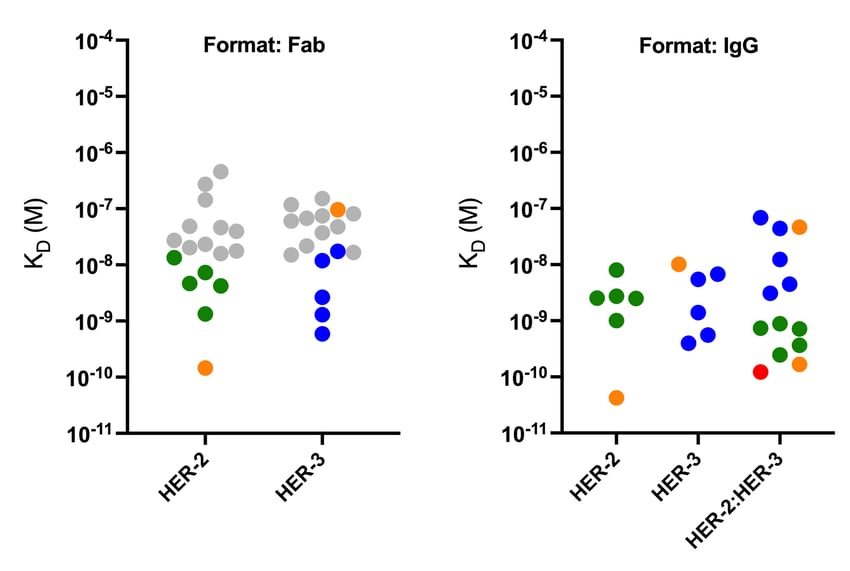
Figure 1 copy

Green: specific binders from HER2 arm, selected for further studies

Blue: specific binders from HER3 arm, selected for further studies

Orange: existing benchmark, single specificity arms

Red: existing benchmark, in bispecific format


Affinity of the hits identified from the HER2 and HER3 discovery campaigns. A Fab screening (left panel) identified several specific, high affinity clones that were reformatted to IgG (right panel) for subsequent testing.

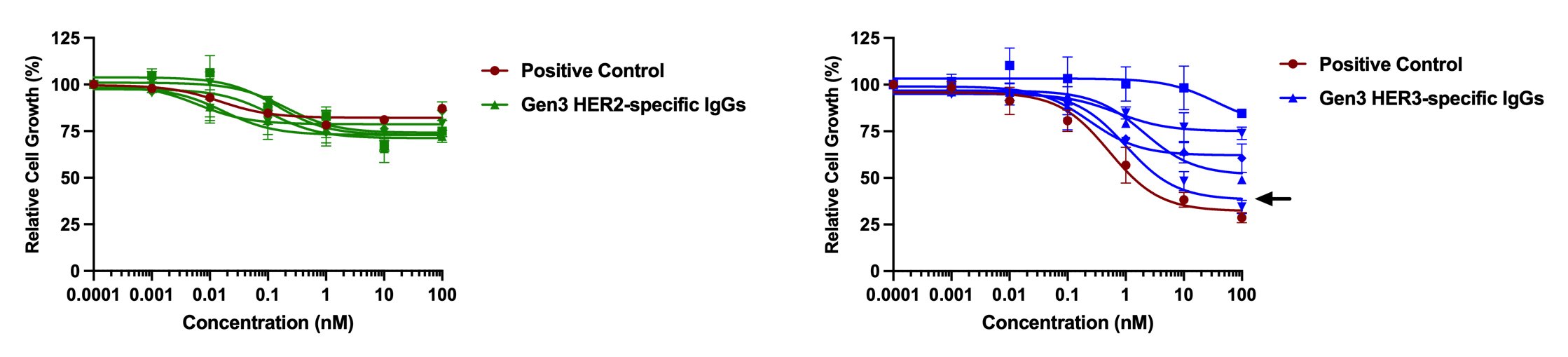
Format: IgG, potency assessment

Figure 2 copy


Potency assessment (cell survival) on cancer cell line MDA-MB-175VII; HER3 clone 105 displayed the highest potency and was selected for reformatting to bi-specific format in combination with several different HER2 clones.

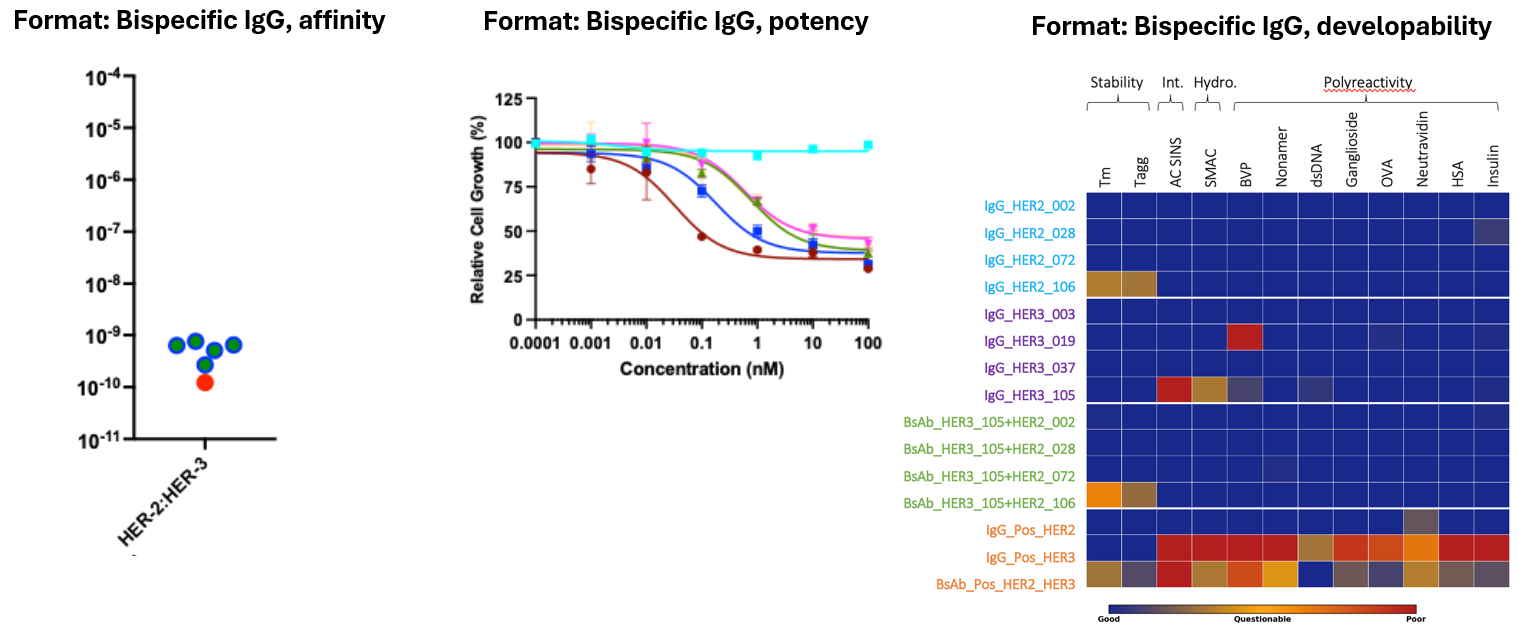
specifica-charts


Antibodies reformatted to bispecific format show maintained binding and high, subnanomolar affinity to the HER2:HER3 heterodimer (left panel), as well as potency in a cell-based assay (center panel); importantly, developability assays (right panel) show remarkable characteristics, with excellent developability exceeding that of the benchmark bi-specific antibody.


The Specifica cLC platform successfully identified sub-nanomolar, potent, highly developable bi-specific antibodies straight from a de novo discovery campaign.

Get In Touch

Contact Us

Contact Us

If you would like to get in touch with us please use the contact form or email address below.