
Specifica’s Generation 3 platform combines phage display, yeast display, next-generation sequencing and guided selection to discovery diverse, target-specific antibody leads. We deliver drug-like antibodies straight from selections—bringing developability considerations into discovery from the start and reducing the need for downstream optimization.
Our Approach to In Vitro Antibody Discovery
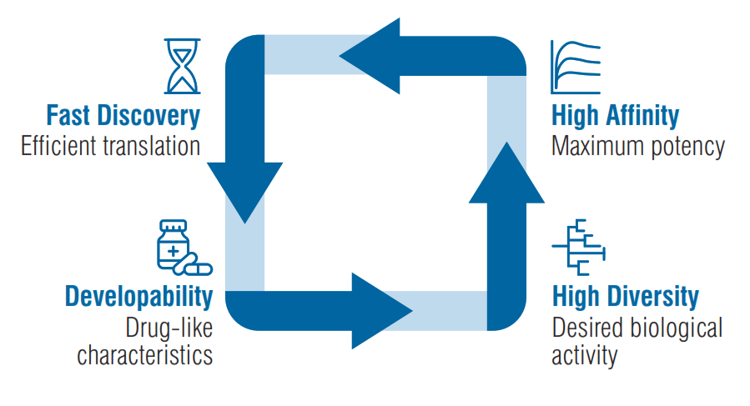
Successful antibody discovery programs must balance four competing requirements: affinity, specificity, developability and diversity. Our in vitro selections from naïve libraries are custom-designed to allow rapid and direct selection for specific properties of interest, rather than just generic binders. Our technical team collaborates with the customer throughout the process, making adjustments to ensure we meet your goals.
Our approach delivers:
-
-
Speed to a promising lead candidate
-
Antibodies against challenging target epitopes
-
Identification of multiple distinct antibody families
-
Reduced downstream optimization requirements
-
Greater confidence when advancing candidates toward development
-
Our formats include VHH, scFv-IgG, and constant light chain libraries. The outputs can be reformatted to any format desired by the customer, including Fab, custom Fc, VHH-Fc, KiH bi-specifics, etc. for final validation of affinity and binding properties.
Gen 3 Antibody Discovery Performance
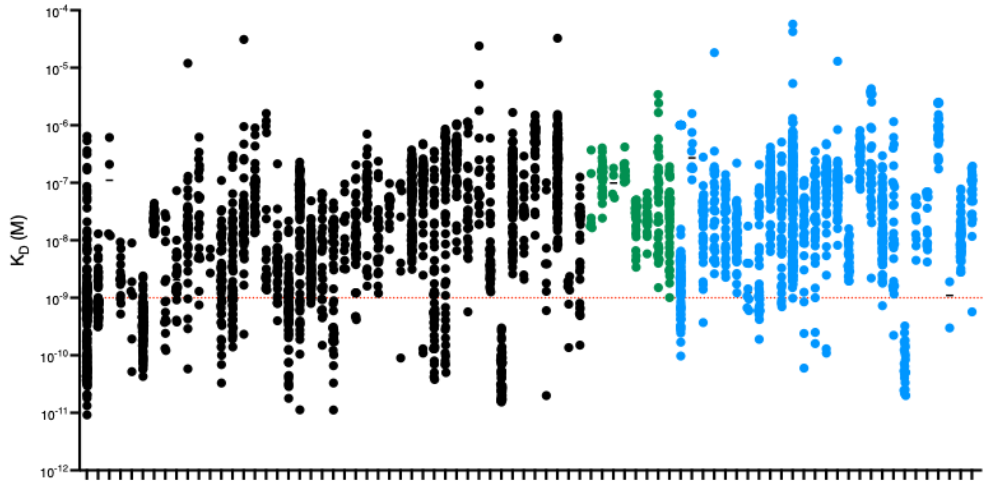
Each column represents a unique target.
Black - ScFv
Green - peptide MHC
Blue - VHH
-
- High affinity – High-affinity antibodies directly from initial discovery, reducing or eliminating the need for subsequent affinity maturation.
- >75% of scFv campaigns, excluding pMHC campaigns, yield at least one sub-nanomolar binder
- >20% of scFv binders are sub-nanomolar, with 60% of antibodies having affinities below 10 nM.
- Exceptional diversity – Large naïve libraries incorporating more than 1018 unique, naturally derived HCDR3s enable discovery of broad panels of antibodies targeting diverse epitopes. NGS analysis can identify hundreds of distinct antibody clusters from selection outputs.
- Designed for developability – Gen 3 libraries use therapeutic antibody scaffolds and natural CDR diversity, with sequence liabilities removed from 5 of the 6 CDRs. More than 80% of antibodies characterized from the platform have no measurable biophysical liabilities.
Select for the biology you need – Our integrated phage and yeast display workflow allows antibodies to be selected, rather than simply screened, for properties such as species cross-reactivity, domain specificity, affinity, ligand competition and epitope specificity. - Broad sequence and epitope diversity – NGS combined with sequence clustering enables identification of large numbers of distinct antibody families, increasing the opportunity to discover antibodies with differentiated binding and biological properties.
- Fast, fully in vitro discovery – Rapid discovery without the timelines or biological constraints of an immunization campaign.
- High affinity – High-affinity antibodies directly from initial discovery, reducing or eliminating the need for subsequent affinity maturation.
Discuss your Project
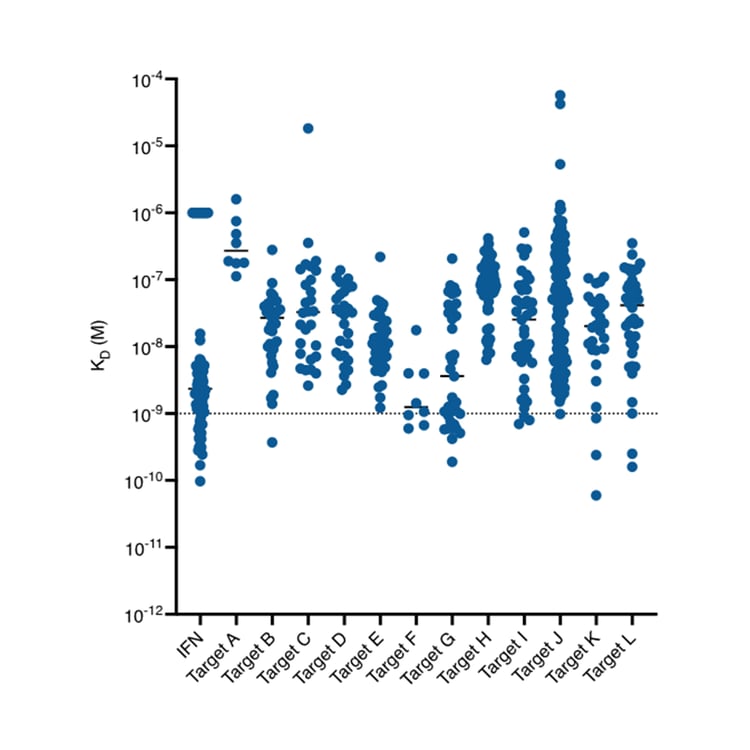
VHH / single-domain antibody discovery
Specifica’s VHH libraries are built on therapeutic scaffolds and designed to combine broad diversity with developability. Discovery campaigns of VHH libraries allow flexible therapeutic design without requiring an immunization campaign.
-
- Higher rate of success – our approach is also successful when homology between a human and camelid target is high, a scenario where immunization approaches often fail
-
Broad diversity – our phage display libraries far exceed the diversity of immunization, and sorting via yeast display provides additional capabilities to enable selection for desired properties
-
High affinity – exceptional binding due to the preserved CDR regions
-
-
>50% of campaigns yield at least one sub-nanomolar binder
-
>50% of binders <10nM and ~5% of binders are sub-nanomolar
-
-
-
High specificity – controlled selection conditions allow you to focus on specific regions of your target antigen
-
Developability – >70% of VHHs have two or fewer biophysical liabilities
-
More human than humanized VHHs – fully human CDRs within humanized frameworks helps reduce downstream engineering through improved safety and therapeutic efficacy
Read about our success in developing single-domain (VHH) antibodies from our libraries in this 2025 article in mAbs.